
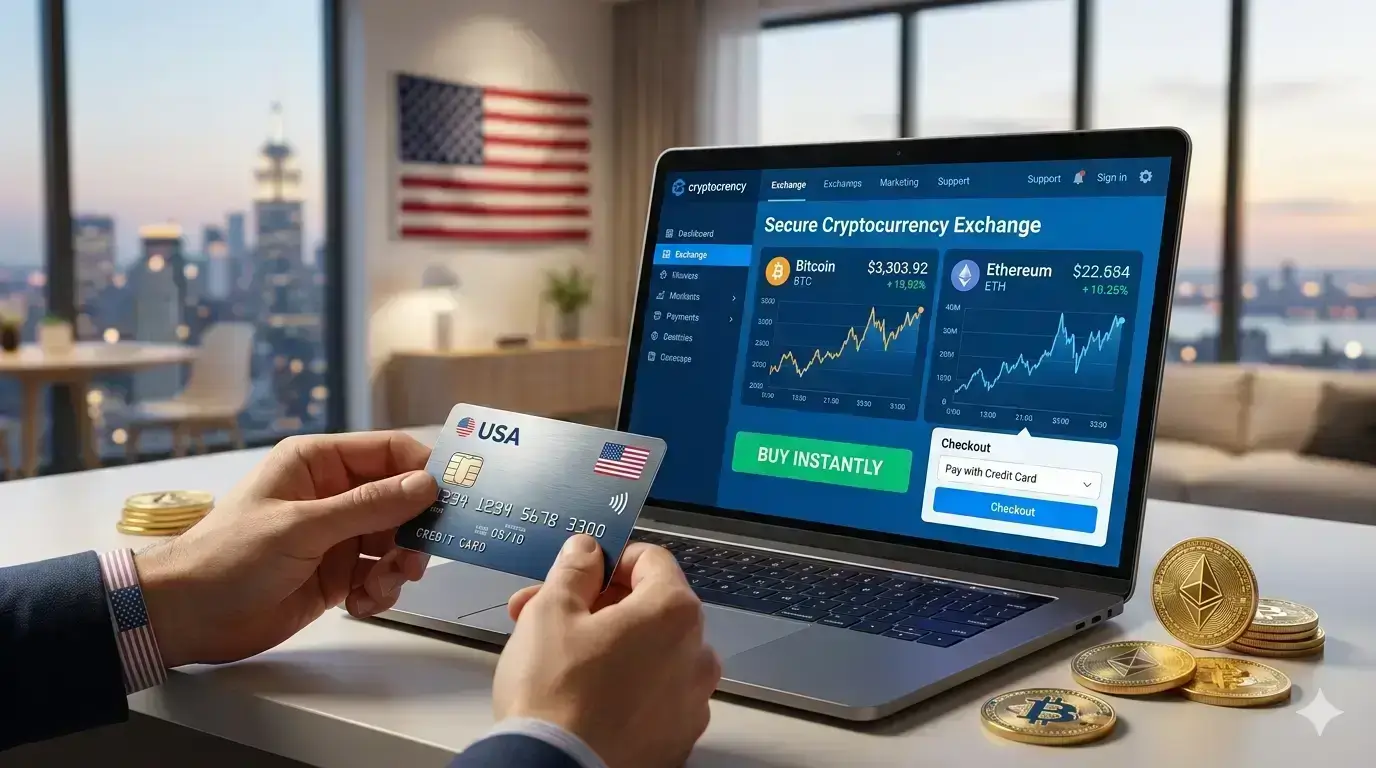
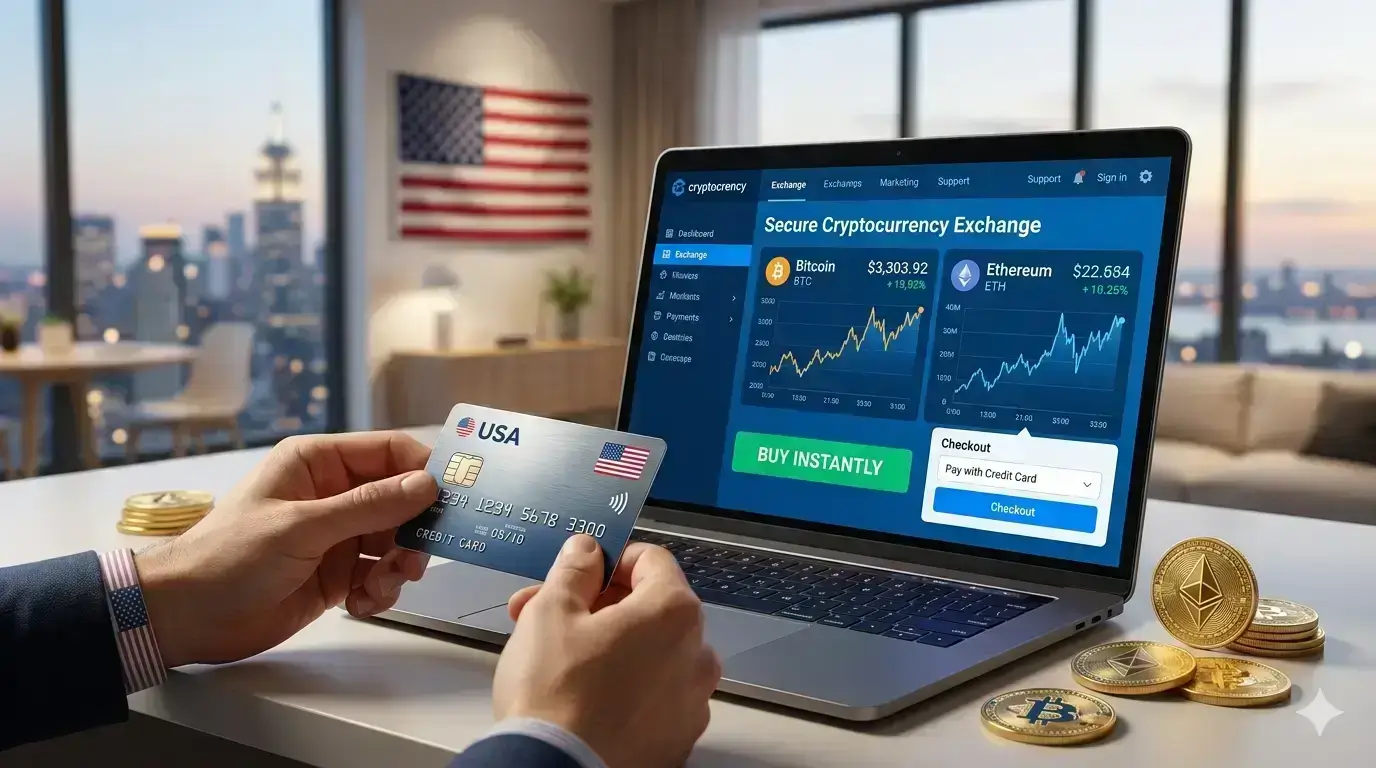
Buying crypto with a US credit card? Watch out for high cash advance fees.
The cryptocurrency market moves fast, and sometimes you need to seize a market dip instantly.
If you are looking for the fastest way to fund your digital wallet, learning how to buy crypto with credit card US platforms support seems like the most convenient option.
After all, it offers instant processing and allows you to invest without dipping into your immediate checking account balance.
Sure, buying Bitcoin or Ethereum with a credit card is technically allowed in the US, but major banks make you jump through quite a few hoops.
American card issuers don’t make it easy to buy crypto—and when they do allow it, the extra fees bite hard.
Before you drop your card info into any app, get clear on three things: which exchanges actually take it, how your bank might reject it, and the extra fees that will drain your returns.
Ahead, you’ll find out which US exchanges process card payments, how the buy process works, and how to avoid getting hit with unexpected charges.
Can You Buy Crypto with a Credit Card in the US? (The Legal Reality)
The short answer is yes, it is legally permissible. Federal regulations in the US don’t stop you from using a credit card to buy crypto.
Even so, most major US credit card companies still decline crypto purchases.
The biggest issue here isn’t federal law—it’s bank policies.Lately, big card issuers have put stricter limits on crypto buys to guard against scams, illicit money, and unpaid debt when prices plunge.
Major US Card Networks & Bank Policies
Before buying, here is what you should know about how big US banks and card networks react to crypto.
- Visa and Mastercard: These payment networks leave the decision up to the individual bank that issued your card.You’re good to go as long as your bank’s Visa card handles crypto buys.
- American Express (Amex): Amex maintains highly restrictive policies. While some third-party merchant transactions may clear, they are subject to low daily limits and stringent fraud monitoring.
- Discover: Discover generally blocks all direct cryptocurrency purchases on its network.
Which Major US Banks Block Crypto Purchases?
If you’re using a card issued by one of these big banks, your crypto transaction probably won’t go through.
- Bank of America
- Capital One
- Chase Bank
- Citi Bank
Another Option: Direct credit card buys get turned down all the time, so plenty of US traders connect their cards to Apple Pay or Google Pay on platforms that allow it.
This routing method can occasionally circumvent bank-imposed MCC restrictions.
The Hidden Costs: Why You Should Be Careful
Buying crypto with plastic is convenient on paper—until you get smacked with processing fees.It’s easily one of the most expensive ways to buy crypto in the US.
If you’re not paying attention, fees alone can eat up 8% to 15% of your capital right out of the gate.Here are the hidden costs you must watch out for:
1. Cash Advance Fees (The Primary Pitfall)
In the US, practically all major card providers lump crypto purchases in with cash advances, putting them in the same bucket as an ATM run.
- The Cost: You will be charged an immediate fee of 3% to 5% of the total transaction amount (or a flat $10, whichever is greater).
2. High Cash Advance APR (Zero Grace Period)
Unlike regular credit card purchases that give you a 21-to-25-day grace period to pay off your balance without interest, Cash Advances have NO grace period.
- The Catch: Interest kicks in the exact second your purchase gets approved. On top of that, cash advance APRs are brutal—frequently landing between 25% and 30%+.
3. Exchange Processing Surcharges
Crypto platforms have to pay extra to process credit card payments, and they pass that fee directly onto you.
- The Real Cost: On top of everything else, top exchanges usually tack on an extra 3% to 4.5% convenience fee just to swipe a credit card.
Compare that with an ACH bank transfer, which costs pennies on the dollar—rarely exceeding 0.5%.
⚠️ To put that into perspective: If you put $1,000 of Bitcoin on a US credit card, you’re looking at around $40 in exchange fees and a $50 cash advance fee before you even hold the coins.Out of that $1,000 charge, you only pocket $910 in Bitcoin.
Worse yet, daily interest on the total amount starts racking up right away.
4. Credit Score Impact
Why should you care about credit utilization? Simple—it drives almost 30% of your total FICO score.
All it measures is the slice of your total credit line you’ve spent.Maxing out your card or carrying a heavy balance to buy volatile crypto assets can cause your credit score to drop rapidly.
Best Crypto Platforms to Buy Crypto with Credit Card in the US
Heavy regulatory oversight has left crypto buyers with very few options when it comes to using US-issued credit cards.
That said, a handful of fully compliant platforms and Web3 gateways still let you make these quick buys safely.
Here are the top choices for US users:
| Platform | Best For | Payment Method | Typical Processing Fee |
| Coinbase | Security & Compliance | Apple Pay / Google Pay integration | ~3.99% |
| Gemini | Security-First Investors | Direct Visa & Mastercard linking | ~3.49% + trading spread |
| BitPay / Web3 Gateways | Self-Custody Wallets (MetaMask, Trust Wallet) | In-wallet checkout via Banxa, MoonPay, or BitPay | 3.5% – 5.0% |
| Crypto.com | Altcoin Selection | In-app credit/debit card purchases | 2.99% – 3.99% |
How to Buy Crypto with a Credit Card in the US (Step-by-Step)
As long as fast settlement is worth the higher fees to you, getting crypto safely through a licensed domestic exchange is a painless process.
Here is how it works, step by step:
1.Choose a Licensed Platform:
Go with a platform that plays by US financial rules, like Coinbase, Gemini, or Uphold.
2. Complete KYC Verification:
Make sure you have your SSN or a government-issued ID on hand to complete standard identity checks and unlock full trading limits.
3. Set Up a Digital Wallet Workaround:
Banks frequently decline direct card inputs on crypto exchanges.
You can easily bypass this headache by adding your credit card to Apple Pay or Google Pay beforehand.
4. Make the Purchase:
Open the buy screen, pick the cryptocurrency you want to grab, set your digital wallet as the payment option, and tap to confirm.
Pros and Cons of Using a Credit Card for Crypto
Pros
- Instant Execution: Funds settle immediately, letting you capitalize on brief market dips.
- Speed & Convenience: Skips the multi-day clearing window associated with traditional ACH transfers.
- Robust Security: Regulated exchanges provide enterprise-grade encryption for card transactions.
Cons
- Cash Advance Penalties: Triggers an upfront 3% to 5% issuer surcharge.
- Immediate Interest Accrual: Zero grace period; high-APR interest builds from Day 1.
- High Decline Rates: Significant likelihood of automatic transaction rejection by major US banks.
Conclusion
For US buyers who need immediate liquidity to capitalize on fast shifts, credit cards offer an instant way to get skin in the game.
That said, since US banks process these buys as cash advances, it’s easily one of the priciest ways to build up your holdings. For those rare moments when every second counts, linking your card to Apple Pay or using a direct exchange app like Gemini gets the job done.
But for long-term investing or larger amounts, switching to ACH bank transfers or wire deposits is highly recommended to keep your hard-earned money from being eaten up by hidden fees.
Frequently Asked Questions (FAQs)
Q1:Do major US banks block credit card crypto purchases?
Ans: Yes, almost across the board. Wall Street heavyweights including Bank of America, Citi, and Chase maintain automated blocks on card-funded crypto orders to limit potential defaults and security issues.
Q2: Will buying crypto with a credit card earn me points?
Ans: Not going to happen, unfortunately. Banks label crypto purchases as cash advances—similar to taking cash out of an ATM—so they won’t trigger any cash back, travel miles, or rewards points.
Q3: Is there a way to avoid high fees and still buy crypto easily?
Ans: For sure. Instead of taking the credit card route, opt for a crypto debit card. You can spend stablecoins penalty-free and get crypto cashback without worrying about bank blocks or cash advance rates.
Disclaimer: The information provided on Trendmapx is for informational and educational purposes only and does not constitute financial, investment, or legal advice. Cryptocurrency investments are highly volatile and risky. Buying crypto with a credit card can lead to high interest rates, cash advance fees, and potential debt. Always do your own research (DYOR) and consult with a certified financial advisor before making any financial decisions.