
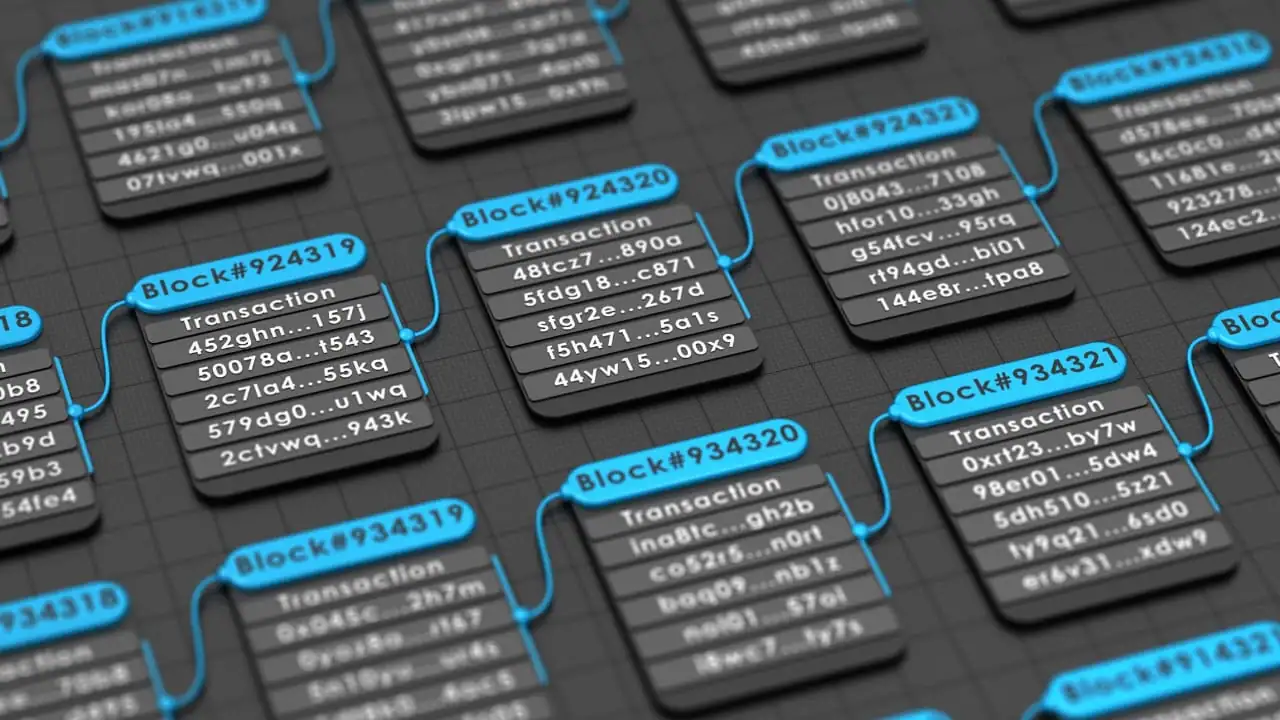
Visualizing blockchain immutability—each block securely references the hash of the one before it.
Another week, another nine-figure exploit flashing across financial headlines. As digital assets continue to face peripheral threats, many investors ask: can blockchain actually be hacked?
The Pillars of Blockchain Security Architecture Cryptographic Hashing & Immutability
SHA-256 basics explained simply.
The Digital Blender and the Tamper-Proof FingerprintSHA-256 levels the playing field for data.
Whether your input is a lone typo or gigabytes of transactional history, the algorithm crushes it down into a uniform footprint: a 256-bit string that always spans exactly 64 hexadecimal characters.
A Strict One-Way Street (Irreversibility):
Puree some strawberries, a banana, and almond milk together, and you get a distinct, uniform blend—that’s your hash. The process only goes one way, though.
Staring at that final pink liquid tells you virtually nothing about how many berries were used. You can hash gigabytes of data in an instant, but reversing the calculation to pull out the original document is practically hopeless.
The Unbreakable Digital Fingerprint (Data Integrity):Short greeting or gigabytes of tax records? Doesn’t matter.
The output is strictly locked at 64 characters.Here’s the wild part: change just one period somewhere in a 500-page manuscript, and the new hash won’t look anything like the old one. In tech, that massive ripple is known as the avalanche effect—and it makes sneaking even a tiny tweak past the network dead on arrival.
Mining (Proof of Work) = A Global Power ball Lottery:Mining boils down to an absurdly simple brute-force game.
Machines take the latest block, slap a random counter—the nonce—onto it, and churn it through the algorithm. The goal? You just feed in one number after another until the Character output finally spits out that long run of zeros.(e.g., 000000000000abcd…).There are no shortcuts or algebraic formulas.
Every second, countless specialized mining rigs churn through trillions of random solutions. The moment one finally cracks the right hash, it earns the right to validate the block and pocket the reward.Bitcoin Addresses = A Cryptographic Privacy Shield:Bitcoin hashes your public key using SHA-256 and RIPEMD-160 rather than putting it on full display.
The result is your wallet address.Anyone can see your address to send funds, but nobody can reverse-engineer your underlying private signing keys from that public string.
How altering even a single block causes the whole chain to fail?.
Locked Envelopes on an Open Ledger each block as a heavy-duty envelope packed with transfer records:
The Merkle Root: A Master Seal for All ReceiptsThe network blends every single receipt inside into one central digital imprint. Alter just one zero on a $10 bill, and the entire seal breaks into a completely new pattern.
Block Header & Hash: The Exterior Tracking CodeInspect the outer barcode before you touch the package. It matches that master seal and the contents inside. If that seal was lifted or the papers shifted in transit, the code will look visibly warped and unreadable.
Chain Link = The Previous Envelope’s Reference:Every new envelope strictly logs the barcode of the envelope right before it. On its cover, Envelope #3 features the barcode from Envelope #2, which in turn features the code from Envelope #1.How Does the Chain Break?Say an attacker messes with Envelope #2:The inside stamp (Merkle Root) changes the second anything moves.That alters the outside barcode (Block Hash) completely.Envelope #3 is still tied to the old barcode, snapping the connection clean off. That one mismatch brings down every block after Envelope #2. Honest nodes catch the slip-up in a millisecond and kill the bogus block dead in its tracks.
Decentralized Consensus Mechanisms
Proof of Work (PoW) vs. Proof of Stake (PoS)
Picture running a fleet of diesel engines in a warehouse all day and night. That’s essentially how Proof-of-Work works—it chews through enormous amounts of grid power just to settle blocks.
PoS ditches the heavy hardware entirely; validators settle blocks on standard server infrastructure, slashing electrical demand by more than 99.9%.
The Buy-In Costs:Mining on PoW is an industrial-scale operation. You can’t just let your gaming rig run overnight and expect to get anywhere; it takes walls of custom ASIC units and sweetheart deals with power companies to turn a profit. PoS flips the script. Instead of burning through electricity and expensive hardware, you just need the staking deposit—the actual node software runs fine on an ordinary PC without spiking your electric bill.
The Centralization Paradox: On paper, PoS levels the playing field by letting lightweight nodes join from anywhere. In practice, yield scales proportionally with balance size. Liquid staking protocols and crypto exchanges pool money from everyday investors, building massive voting blocks in the process. Over time, that slowly brings centralization back into the network.
Issuance Dynamics: PoW miners face relentless fiat overhead to cover power bills and cooling infrastructure. Networks must sustain high token issuance via block rewards to keep mining profitable. Since PoS validators have low hardware and energy costs, networks can drastically trim their yearly inflation rates without giving up on security.
Unlike PoS where bad actors get slashed, a 51% PoW attacker keeps their hardware safe. The network simply can’t touch their mining rigs, leaving the door wide open for them to reorganize blocks and strike a second time. PoS flips the risk onto the attacker’s balance sheet: rogue validators have their pledged assets directly liquidated on-chain through programmatic slashing.
The Forking Defense:Money can buy voting power, but it cannot buy user consent. If a rogue player seizes network control, the ecosystem coordinates a clean fork. Honest participants move their liquidity and traffic to the updated software, leaving the attacker ruling an abandoned chain with a price tag of zero.
Why 51% Attacks on Flagship Networks Are Economically Irrational
Picture a corporate shareholder vote where overriding governance requires seizing outright majority voting equity in the enterprise.
Proof of Work (Bitcoin)
You cannot brute-force Bitcoin without controlling more computational firepower than every legitimate mining pool on Earth. Securing that much silicon and continuous energy takes deep-state level capital. But here is the fatal flaw: the moment an attacker pushes through a fraudulent double-spend, the ecosystem coordinates around a clean chain. The rogue miner spent billions just to rule an empty network with a market cap of zero.The outcome: billions in specialized ASIC chips and energy infrastructure turn into scrap metal overnight.
Proof of Stake (Ethereum)
You don’t break this network by hoarding ASIC miners or buying out a power plant. It comes down to cold, hard cash. An attacker has to lock billions of dollars worth of coins right into the protocol’s contracts. Cornering that much liquid supply would cause severe supply shock, dramatically pumping the asset price during the accumulation phase. The second the attacker broadcasts a fraudulent block reorganization, internal protocol penalties burn that entire collateral stake.Leading chains stay secure because attacking them is financial suicide. Breaking base-layer consensus takes a ridiculous amount of capital—and the moment an attacker tries to game the system, their own funds are the first thing to get wrecked.
Asymmetric Encryption: Public Keys vs. Private Keys
Blockchain self-custody discards standard single-factor passwords in favor of mathematically paired key Architecture
| Feature | Public Key / Public Address | Private Key |
| Primary Utility | Public routing target for incoming transfers | Secret credential for transaction signing and custody verification |
| Exposure Level | Publicly accessible (broadcast openly) | Strictly confidential (never expose to internet-connected devices) |
| Core Function | Verifies signature validity across network nodes | Generates unforgettable cryptographic digital signatures |
| Banking Parallel | Checking account number / Wire routing ID / Email handle | Physical signature / Secret ATM PIN / Wire authorization code |
The Street Mailbox Analogy
Your public address works like a standard curbside mailbox. Anybody can drop funds into it, and your address is stamped right on the outside so people know where to send mail.On EVM networks, addresses derive from hashing the raw public key with Keccak-256. You can post this identifier publicly across the web without jeopardizing the safety of the contents inside.
Think of your private key as the lockbox combination. Anyone can make a deposit from the outside, but transferring or spending that balance takes your personal access code.Your private key is a secret 64 Character hexadecimal credential. Every time you broadcast an outbound transfer, this credential computes a single-use digital signature tied exclusively to that outbound payload.
The Cryptographic Trapdoor:Turning your private key into a public address takes a few clock cycles on a cheap phone. Going the other way around, though, hits a hard thermodynamic wall. Trying to reverse-engineer a private key from an exposed public wallet would take more electrical power than every power grid on Earth could crank out before the sun burns out.
Blind Cryptographic Sign-Off:You aren’t giving out your password to send cash. You’re generating a tamper-proof digital signature that works for that one transaction and nothing else.Validation nodes test the signature against your public key in milliseconds. If the equation balances, the network processes the transfer. It’s total mathematical certainty with zero exposure of your private key.
Blockchain Security vs. User-End Vulnerabilities
Did the Vault Break, or Was the Key Stolen? Think of the blockchain as a military-grade vault built with 10-foot-thick reinforced steel. No safe-cracker onEarth can drill through its cryptographic walls using brute-force computing power.Yet, headlines constantly report millions stolen in crypto. How? The vault was never breached—the attackers simply exploited human vulnerabilities to take the key:
- Centralized Exchanges (CEXs) = Private Safety Deposit Box Companies:Storing assets on an exchange is like handing your gold bars to a third-party depository. The company holds the master key, not you.When the people running the show steal customer deposits or their online storage gets breached, you lose every penny.
- Smart Contract Bugs & Rug Pulls = A Broken Smart Lock That Lets the Thief Walk In:Imagine mounting a third-party smart lock on your vault door.Nobody is breaking through the steel door, but they don’t have to—a developer backdoor leaves the lockwide open.A hacker pops the lock open without ever touching the vault walls.A rug pull is an inside job from day one. The dev deliberately codes in a backdoor, empties the liquidity pool,and vanishes into thin air.
- Phishing & Approval Scams = Signing Away the Deed:It is like opening the door for a fake delivery driver and signing a clipboard on autopilot. What you actually signed was a transfer of your property title. A reinforced steel safe does not mean much if you willingly authorize the paperwork that hands over your assets.
- SIM Swapping = Hijacking the Mail Carrier:An attacker social-engineers your cellular carrier (e.g., Verizon or T-Mobile) into porting your phone number to their burner device.Catching that text message verification is the golden ticket for a hacker. In a few quick clicks, they’ll lock you out with a fresh password and siphon every cent off the exchange.
What “Not Your Keys, Not Your Coins” Actually Means
The Private Key Is the Only Key: Cryptocurrencies do not sit inside your hardware wallet or mobile app; they live as immutable records on the distributed ledger. Your private key is simply the sole cryptographic credential that proves ownership and signs outbound transactions.
Lose your seed phrase, and you lose your money—period. Keep it out of screenshots and unencrypted clouds, because if it leaks or disappears, no support desk or authority on earth can recover it for you. There is no “Forgot Password” button on a blockchain.The vault’s math hasn’t failed once. Stolen funds almost always boil down to careless key management—phishing tricks, risky downloads, or putting faith in the wrong people.
Best Practices to Maximize Blockchain-Level Security
A Bank Safe Deposit Box vs. Apple Pay / Venmo
Hot vs. cold wallets really just comes down to a single choice: convenience or bulletproof security.A hardware device acts like an offline bank vault. It’s built strictly for long-haul holdings—the crypto equivalent of gold coins locked away in a private depository that zero hackers can touch through a wire.
It has zero direct connection to the internet. Getting your hands on those reserves takes physical effort: an in-person ID check and a real key in the slot. Remote hackers are powerless here. Even with full access to your home PC or cell phone, they hit a dead end because the assets simply aren’t online.
Software / Hot Wallet = Apple Pay, Venmo, or Cash App on Your Phone:This is your digital spending wallet built for day-to-day convenience. It stays connected to the internet 24/7.We love the speed of tapping to buy a latte or split dinner with friends, but that easy convenience comes with an always-on digital footprint.If malware infects your operating system.If you click a deceptive phishing link.Or if you blindly authorize a malicious recurring charge.Your account balance can be wiped out in an instant.
Quick Comparison
| Feature | Hardware Wallet (Cold Storage) | Software / Hot Wallet |
| Banking Analogy | Bank safe deposit box / vault (long-term reserve) | Apple Pay / Venmo (daily pocket money) |
| Connectivity | 100% offline (air-gapped from the web) | 24/7 online connection |
| Convenience | Slower; requires physical button confirmation | Instant, one-click transactions |
| Attack Surface | Immune to remote online hacks and keyloggers | Exposed to browser exploits, malware, and rogue links |
Nobody in their right mind leaves their life savings sitting in a Venmo account. You keep serious money tucked away in a real bank and move twenty bucks over when it is time to split lunch. Crypto works the same way: keep your long-term stash locked on a cold hardware wallet, and only put what you are ready to spend on a connected phone app.
Multi-Layer Account Hardening
You can’t pull cash from an ATM just by knowing the PIN. You need the plastic card right there with you. That simple friction is why real-world security always relies on two separate hurdles. Good digital defense works the exact same way: you pair a secret you know (your password) with a physical item in your hands (your phone or a dedicated hardware key).Not all two-factor authentication (2FA) methods protect your funds equally:
1. SMS-Based 2FA = Mail-Order Disposable Slips (Weak Security):Tying your bank access strictly to text alerts is like leaving your front door key under the doormat.All a scammer needs is one convincing phone call to your cellular provider to pull off a SIM swap. When your number gets hijacked onto a burner phone, every single verification code that should protect you goes straight to someone else. SMS is the lowest acceptable baseline of security.
2. Authenticator Apps (Google Authenticator / Duo): An Offline Digital Token (High-Tier Protection)It works just like a dedicated corporate SecurID fob, right on your screen. The app cycles through a new, time-sensitive code every half minute. Since these six-digit pins generate locally without sending a single text message, a SIM swap cannot touch them.The Advantage: These Time-based One-Time Passwords (TOTP) generate locally inside your smartphone without traveling over cellular networks. A hacker cannot intercept this code via a SIM swap.
3. YubiKey (Security Key) = An Armored Car Key for Your Crypto (Fort Knox Level):It works like a tamper-proof smart card that no internet scammer can duplicate. Whenever you make a transfer or sign into your account, you plug the token into your machine or tap it on your mobile, then physically press the gold contact to open the door.The Advantage: FIDO2/WebAuthn hardware keys are mathematically phishing-resistant. A slick phishing clone might trick your eyes, but it will never fool a hardware key.During the browser’s cryptographic handshake, it instantly spots that the web domain is bogus and flat-out refuses to cough up your login credentials.
The Comparison (Clean Markdown Table)
| Security Level | Real-World Banking Equivalent | Protection Tier | The Real Vulnerability |
| Hardware Key (YubiKey) | Heavy-duty chip card plus a physical thumbprint | Top Tier | Virtually untouchable by remote phishing links or carrier SIM hijacks |
| Authenticator App (TOTP) | A handheld pocket token spitting out 30-second codes | Solid Defense | Shuts down SIM swappers, though a user can still be fooled into copy-pasting codes into fake portals |
| SMS / Text Prompts | An unencrypted postcard sent through the regular mail | Bare Minimum | Dead simple for bad actors to intercept via carrier-level SIM ports |
| Password Alone (Zero 2FA) | A bank vault locked with just a four-digit garage keypad | Disaster Waiting to Happen | One credential dump on the dark web wipes out the entire balance |
Closing Takeaway
No support for authenticator apps or physical keys? Don’t open an account. Period.Keeping your money there is like leaving cash with a banker who refuses to put a lock on the front door.
Withdrawal address white listing on platforms like Coinbase/Kraken.
A Crypto Wallet Address vs. ACH Routing & Wire Transfers
A crypto address is just an account ID for the blockchain, working identical to a bank account number, wire routing info, or a Zelle profile.
Wallet Address = Account Number & Routing Transit Code: To get paid by direct deposit or ACH, all you ever have to share is your basic account number or payment tag.
Public blockchain wallets mirror this setup completely: pass along your wallet address to take in tokens without ever putting your private spend keys at risk.
Distinct Network Routing Protocols (Prefix Formats):You wouldn’t send a bank wire with the wrong routing digits, and the same logic applies to public keys. Bitcoin networks organize destinations by their prefixes so you know what you’re dealing with:
1 for classic Legacy accounts
3 for Nested Seg Wit setup sb c1 for newer, lower-fee Native Seg Wit and Taproot formats
- Legacy (P2PKH): Begins with 1
- Nested SegWit (P2SH): Begins with 3
- Native SegWit (Bech32): Begins with bc1q
- Taproot: Begins with bc1p
Ethereum & EVM-compatible chains invariably begin with 0 x followed by 40 hexadecimal characters.
Sending funds to the wrong address type is a classic rookie mistake. It’s the banking equivalent of wiring cash into an incompatible ACH setup; the transaction can’t settle, and you have zero recourse to recover it.
Absolute Transaction Finality (Zero Chargebacks or Reversals):If you botch a wire transfer at a normal bank, fraud teams can often step in and freeze the funds. With crypto, there is no safety net. No one runs a blockchain help desk, and there’s no undo button.
Once a transaction confirms on-chain, it is cryptographically immutable. A bad wallet address burns your cash instantly—zero refunds. Get used to verifying the opening characters, the final four digits, and the exact chain path prior to broadcasting any transfer.
Seed Phrase Hygiene
The Building Master Key:
Look at it like a standard commercial workspace. Much like a row of offices secured by individual physical keys, your crypto wallets isolate risk with unique private keys for each network.The individual locks keep ordinary visitors out, but maintenance carries a master skeleton key that overrides all of them. One key, total access, regardless of which door you try to turn it on.
A seed phrase (recovery phrase) is that grand master key.
If a bad actor lifts your recovery phrase, they don’t have to break a sweat hacking separate coins. Those 12 or 24 words give them a backstage pass to your entire crypto stack in a heartbeat.
The Social Security Card & Notarized Power of Attorney:If you drop your physical debit card in the ocean or smash your phone, your money is not gone.
Forget your login at Chase?
If you get locked out, heading to the nearest branch with your government ID and SSN instantly puts your money back in your pockets.With cold storage, the physical hardware itself is entirely expendable—think of it as a disposable keycard. What actually holds your net worth is that string of 12 to 24 recovery words.
Your funds aren’t trapped in the physical plastic. Break the device in half or leave it on a bus; just snag a new one, restore your seed words, and you’re back in business like nothing happened.
A Pre-Signed, Blank Cashier’s Check:
Stashing your seed phrase in your phone’s camera roll, Google Drive, or plain text notes is asking for trouble. You might as well just tape a signed, blank check to your front door.
Online infostealer malware scans consumer devices specifically for strings of 12 or 24 standard BIP-39 dictionary words.
Exposing those words to an internet connection is practically an open invitation to drain your wallet. Keep it strictly analog by stamping the phrase on indestructible steel and locking it away in a safe.
Common Misconceptions About Blockchain Security (Quick FAQ)
Common Misconceptions About Blockchain Security (Quick FAQ)
Q1: Can the underlying blockchain ledger ever get compromised?
The Misunderstanding: Sensational headlines routinely claim the entire blockchain was compromised after high-profile thefts make the news.The Facts: The core protocol layer remains unbroken. Nine-figure crypto breaches are almost universally peripheral failures. Intruders don’t bother attacking the underlying cryptographic rails. They zero in on the easiest attack vectors around the perimeter: exchange hot wallets, compromised credentials, tricking users, and minor contract vulnerabilities.
Q2: Are my coins stored inside my physical hardware wallet?
The Misconception: If you lose or break your hardware device (e.g., Ledger or Trezor), your crypto is destroyed with it.Your crypto never touches the device. It stays on the blockchain 24/7 as an open-ledger entry, while your wallet merely unlocks it. The device simply isolates your private keys from the internet. Got your 12- or 24- word recovery phrase? Then you can set up a new hardware wallet and access your crypto again in a matter of minutes.
Q3: Is crypto completely anonymous and untraceable?
The Myth: Crooks flock to crypto because cops can’t track or see their transactions.The Reality: Public blockchains are pseudonymous, not anonymous. True anonymity on a public ledger is a myth. Every deposit and withdrawal leaves an unchangeable trail. All it takes is one transfer through a regulated US crypto exchange, and analytics firms can strip away the pseudonym to reveal who actually owns the wallet.
Q4: Can customer service or my bank reverse a transaction sent to the wrong address?
The Misconception: If you make a transfer error or fall victim to a scam, an administrator can initiate a chargeback.The bottom line: In the crypto world, there’s no corporate safety net or 24/7 hotline to rescue lost funds. A confirmed transfer can’t be reversed or wiped. Once it settles, that move is final.Your only hope of recovery is getting the recipient to manually transfer the funds back to your wallet.
Q5: Is text-message 2FA actually enough to keep an exchange account safe?
The catch? Getting a one-time code on your phone is hardly an uncrackable shield.The Cold Truth: Relying on SMS is playing with fire. It takes surprisingly little social engineering for a scammer to call your carrier, impersonate you, and swap your phone number over to their own device. The second that happens, your incoming 2FA texts land right in the hacker’s lap. Cut the cord on SMS codes today. Set up an authenticator app, or carry a physical hardware key like a YubiKey if you want ironclad defense against account takeovers.
Conclusion
The Fortress Is Strong, but You Hold the KeyBlockchain technology has fundamentally rewritten the rules of digital asset security.
Thanks to battle-tested math, decentralized validation, and records that simply cannot be rewritten, heavyweights like Bitcoin and Ethereum aren’t cracking open from the inside.
Can someone actually hack the blockchain itself? The short answer is flat-out no.The core code holds the line.The real vulnerabilities lie almost entirely at the user endpoint. In the real world, crypto gets stolen in very predictable ways. An exchange goes under, an audited DeFi protocol gets exploited, a user clicks a malicious link, or someone takes a screenshot of their 12-word seed phrase.Blockchain provides an institutional-grade, impenetrable digital vault, but safeguarding the key to that vault is entirely your responsibility.
Put simply: Blockchain secures the network, but only you can secure your wealth.Take Action Today: Your 5-Minute Security AuditSecurity is not a one-time toggle—it is an ongoing operational standard.
Protect your capital today with these three essential steps:Get a hardware wallet. Keeping your long-term crypto on exchanges leaves you vulnerable to platform freezes and hacks. Pull your funds over to an offline device like a Trezor or Ledger.
Stop using text-message codes. Phone carriers get tricked all the time. Swap out SMS-based two-factor authentication on your email and bank logins before a hacker clones your phone number through a SIM swap.
Upgrade immediately to an authenticator app or hardware security key (such as a YubiKey).Treat digital seed backups like an active leak. Keeping your 12- or 24-word recovery phrase in cloud drives, photo galleries, or saved drafts is a sitting target for infostealers. Wipe every digital copy clean today.Stamp the words onto heavy steel. Lock the plate in a fire safe, strictly offline.
Next Step: Is your crypto self-custody setup truly bulletproof? Download our free Crypto Security Hardening Checklist, or subscribe to our newsletter for real-time Web3 threat teardowns and vulnerability alerts.
Disclaimer: This article is for educational and security awareness purposes only and does not constitute financial, legal, or investment advice. Engaging in self-custodial cryptocurrency management involves inherent risk of asset loss. Always conduct independent research and verify all addresses, software sources, and key-management protocols prior to transacting.